


High-resolution Rotating Piezo Motors for LISA (Laser Interferometer Space Antenna)
0,00 €
The article presents the outcomes of Technology Development Activities (TDA) of several rotating piezo motors for the LISA mission. The Laser Interferometer Space Antenna (LISA) is the European Space Agency’s (ESA) third large-class mission, aiming to become the first spaceborne gravitational wave observatory. It comprises three spacecrafts flying in a precise triangular formation, separated by 2.5 million kilometres. To ensure a stable environment for the scientific pay-load, motors must deliver ultra-low micro-vibration levels and exceptional magnetic cleanliness.
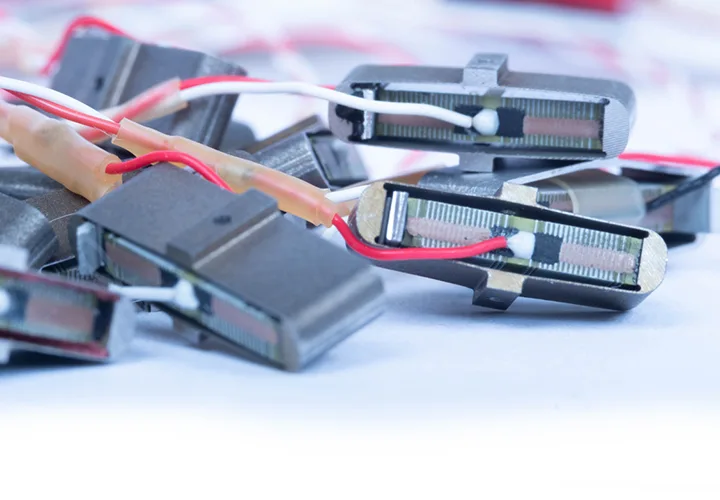
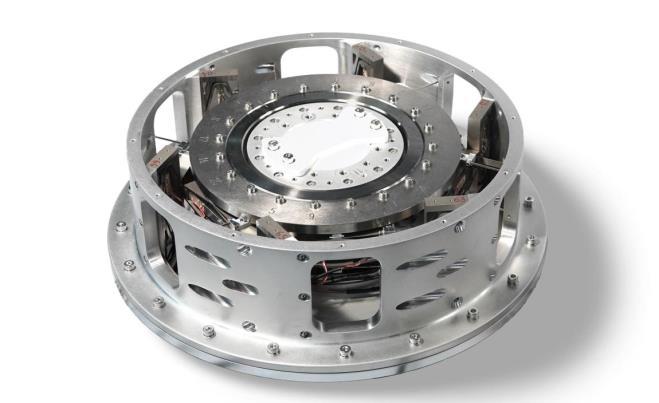
Cedrat Technologies (CTEC) worked within several consortiums on 3 different motors of various sizes in different parts of the satellites. These 3 motors have a large variety of specifications, but are all compact compared to the provided torque, low-speed, non-magnetic, and will answer the environmental constraints of the LISA missions (launch, radiation, cleanliness, low micro-vibration emissivity). In this article, the development processes are described, covering the con-ceptual, preliminary, and breadboard phases. Test results are presented and discussed, along with the lessons learned, demonstrating the potential of inchworm piezoelectric motors for space applications. From these results, CTEC has been selected for the development of the flight models FM (TRL 9) of 3 types of motors. These models should consider the space environment requirement constraints (resistance to launching shocks and vibration, etc) with margins, according to ECSS norms.
Related products
-
Actuators, transducers and motors based on giant magnetostrictive materials
0,00 € Add to downloads -
A new Rotating Voice Coil Motor for Meteosat Third Generation satellites
0,00 € Add to downloads -
Active control of vibrations of a space truss using amplified piezoelectric actuators
0,00 € Add to downloads -
ABC Rotor blades: design, manufacturing and testing
0,00 € Add to downloads