

Defense tracking systems and space communication applications require highly accurate and reliable optical beam control, including Fine & Fast Pointing and Point Ahead Mechanism requirements. Next-generation platforms require steering solutions that combine large angular stroke, high bandwidth, high pointing accuracy, fast response, compact integration, low power consumption, and reliable operation under harsh environmental conditions.Cedrat Technologies (CTEC) develops Magnetic Fast Steering Mirrors (M-FSM) designed to address these challenges. Based on CTEC’s proprietary MICA™ (Moving Iron Controllable Actuator) technology, flexure-based magnetic actuation mechanisms, and embedded eddy current sensors (ECS), M-FSM solutions provide reliable and energy-efficient beam steering for defense and space applications where performance, robustness and compact integration are essential.
Today, CTEC has developed new versions of M-FSM technologies that support a wide range of missions, including InfraRed Search and Track (IRST) systems, Optical Feeder Links (OFL), Optical Inter-Satellite Link (OISL) , and Quantum Key Distribution (QKD) terminals for geostationary satellite applications.
Technology & design
Large stroke. High accuracy. Built for harsh environments.
The performance of CTEC’s Magnetic Fast Steering Mirrors is driven by four advanced technologies:
Magnetic actuation
The M-FSM architecture is based on variable-reluctance magnetic circuits combined with permanent magnet preload. This configuration enables the generation of high magnetic forces while maintaining a compact design. As a result, the system achieves large angular stroke, high linearity, and efficient energy usage.
Flexure-guided mechanism
The mirror is supported by a flexure-bearing structure that ensures frictionless and backlash-free motion.
This contactless guidance technology provides highly repeatable and stable angular movement, which is essential for long-duration missions and operation in harsh environmental conditions.
Integrated position sensing
Angular position is measured using embedded Eddy Current Sensors (ECS), based on eddy currents generated in conductive materials. The sensing elements are integrated directly within the mechanism to improve compactness.Recent developments include integrated proximity electronics that enhance measurement stability, reduce sensitivity to electromagnetic disturbances and improve overall control accuracy.
Advanced control electronics
The M-FSM system is driven by dedicated current amplifiers (MCLA18) capable of simultaneously controlling both axes under an embedded control architecture. A state-feedback control strategy is used to control the first natural mode of the mechanism, enabling high bandwidth and precise tracking for fast beam steering applications.

Defence applications
Precision beam steering for advanced defense systems
Modern defense systems rely on electro-optical and infrared sensors to detect, identify, and track targets in complex operational environments. On airborne, naval, and ground platforms, these systems require extremely accurate line-of-sight stabilization and fine pointing capabilities to maintain performance under platform motion, vibrations, and dynamic operating conditions.
Magnetic Fast Steering Mirrors provide a compact and efficient solution for these requirements. Their combination of large angular stroke, high bandwidth, and precise position control enables real-time compensation of disturbances while maintaining stable optical alignment.
M-FSM systems are integrated into infrared search and track (IRST) systems and other electro-optical tracking applications requiring fast and reliable beam steering under harsh environments.
What are the key benefits of M-FSM in defence ?
- Image stabilization for high-quality imaging
- High-precision line-of-sight stabilization for imaging systems
- Real-time compensation of platform motion and scan-induced disturbances
- Large angular stroke enabling wide-field scanning and correction
- Frictionless flexure-guided architecture for long-term stability
- Compact and lightweight design suitable for airborne and space platforms
- High reliability in harsh environments
Application in InfRared Search and Track (IRST)
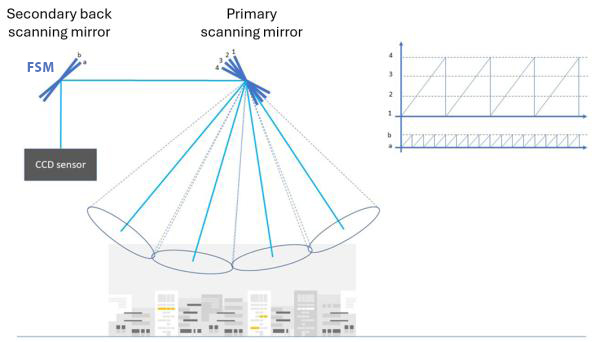
The Infrared Search and Track (IRST) system passively scans wide areas to detect and track objects that emit infrared radiation. To achieve a large field of view, some imaging systems use tilting mirrors to sweep the scene. However, mirror motion during image acquisition can generate a blurred image and cause loss of information while the sensor transfers data to the control system.
By implementing a CTEC back scanning solution based on a secondary magnetic fine and fast steering mirror (M-FSM), the system compensates for the primary mirror motion, ensuring a stable image on the detector and continuous scene coverage for high-quality imaging
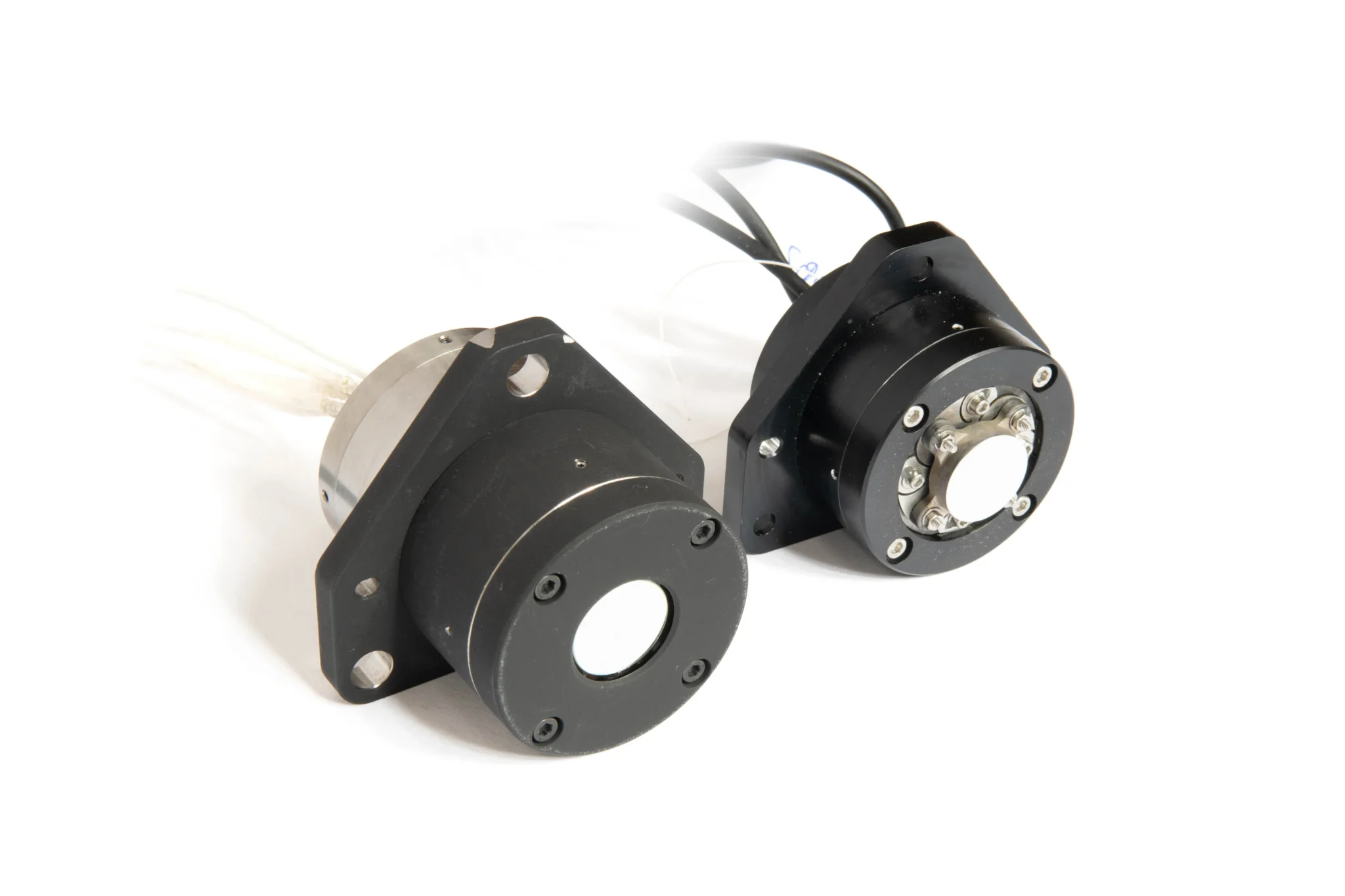
To address these requirements, CEDRAT Technologies has developed an enhanced M-FSM62 solution featuring increased angular stroke, integrated position sensors, and advanced electronics specifically adapted to demanding harsh environments.
Space applications
Enabling next-generation optical communications
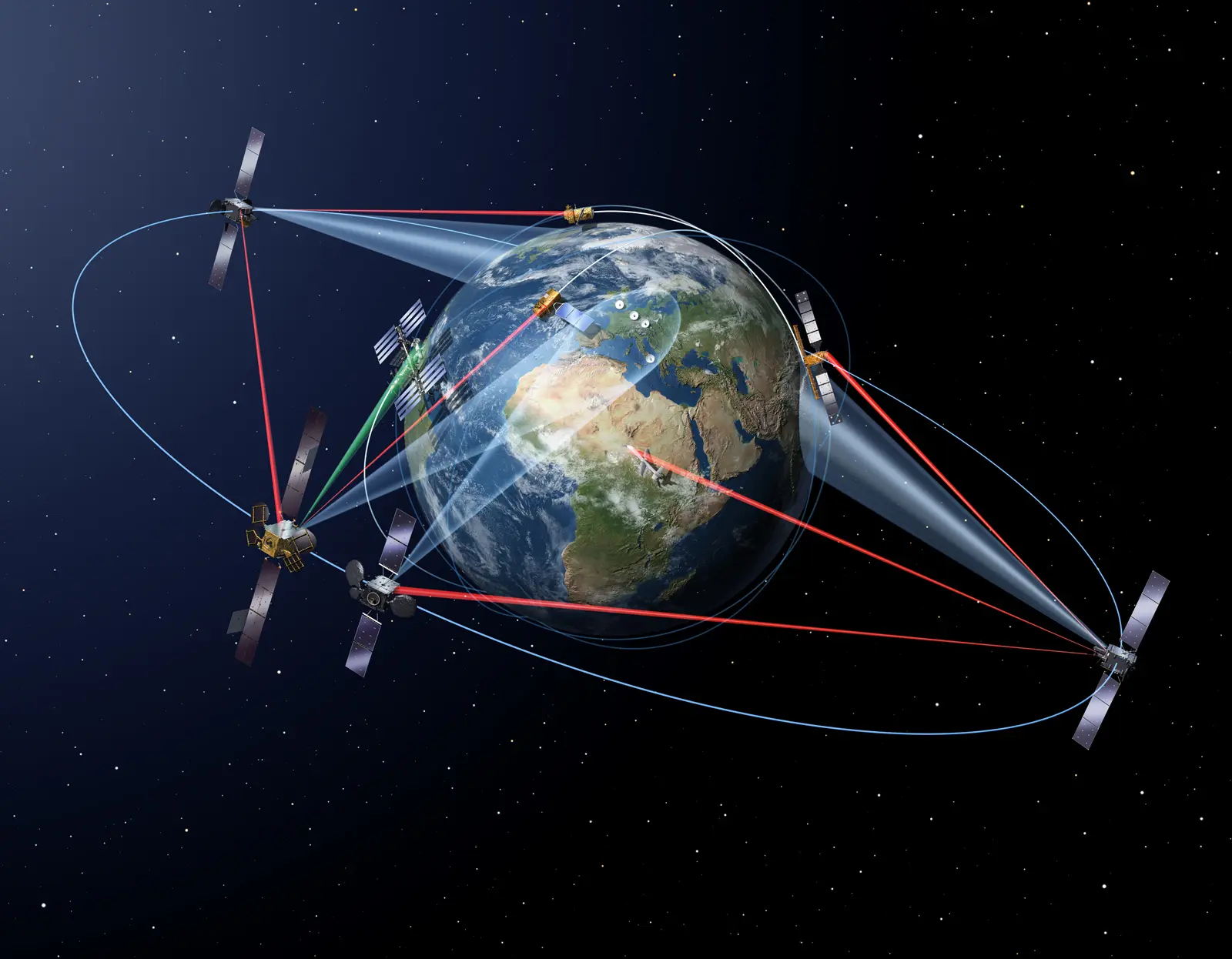
Optical communication is becoming a key technology for future satellite networks, enabling secure, high-data-rate data transmission through optical feeder links (OFL), optical inter-satellite links (OISL), and quantum key distribution (QKD). These systems rely on Fast Steering Mirrors to provide high-bandwidth, fine angular correction, maintaining precise laser beam alignment over long distances.
Space terminals must achieve sub-microradian pointing accuracy while operating under strict size, weight, and power (SWaP) constraints and withstanding launch loads, space environment effects (thermal cycling and radiation), and compensating for platform jitter and atmospheric disturbances. In addition, Fast Steering Mirrors must integrate seamlessly within Pointing, Acquisition, and Tracking (PAT) systems to ensure stable and reliable optical communication.
To address these requirements, CEDRAT Technologies has developed Magnetic Fast Steering Mirrors that combine large angular stroke, high-bandwidth beam stabilization, and precise pointing control to support optical communication terminals.
What are the key benefits of M-FSM in space ?
- High-bandwidth beam stabilization for precise pointing
- Sub-microradian alignment performance
- Large angular stroke for wide correction capability
- Robust operation under SWaP and space environment constraints
- Integration within Pointing, Acquisition and Tracking (PAT) systems
Featured project: SOLiS
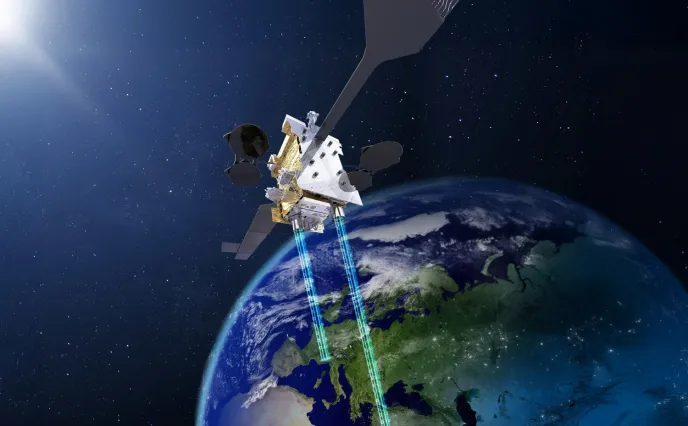
SOLiS (Secure Optical Space Links Service) is a next-generation optical communication program developed to enable ultra-secure, high-capacity optical data transmission through geostationary satellites, supporting intercontinental communication networks with data rates up to one terabit per second.
Within the SOLiS optical terminal, two Magnetic Fast Steering Mirrors (M-FSM45) are implemented: one M-FSM dedicated to beam stabilization and the other M-FSM to Point Ahead Mechanism (PAM) function. Together, they ensure precise laser beam alignment and compensation for satellite motion and pointing dynamics in Geostationary Earth Orbit (GEO) optical links.
The M-FSM45 platform has undergone several improvements to meet the demanding requirements of this mission,including:
- Mirror integration in the final stage of FSM assembly
- Improved ECS position sensor capabilities
- Improved optical wavefront quality (reduced deformation / WFE requirement)
- Improved parallelism between mirror and FSM interface
- Optimized assembly and fine-tuning methodology
Looking ahead
Supporting the future of precision pointing
Future defense and space optical systems require higher performance beam steering to support precise pointing and stable laser links.
Next-generation tracking systems and optical communication systems will require fast steering mirror solutions combining low-SWaP design with high precision and high-bandwidth performance.
CEDRAT Technologies continues to develop Magnetic Fast Steering Mirror technologies, focusing on improved performance, compact design, reduced power consumption, cost optimization, and adaptation to emerging requirements in future space and defense systems.
Get in touch
Let's discuss your beam steering challenge
Whether you are developing advanced defense tracking systems,optical communication terminals or a custom precision pointing systems, CEDRAT Technologies can support your projects from early design through qualification and production.
Our expertise covers precision actuation, control electronics, optical mechanisms, and systems designed for operation in harsh environments, enabling solutions tailored to the most demanding applications.