Cedrat Technologies Frequently Asked Questions
- Fast Steering Mirrors (FSM)
- Piezo Stages (coming soon)
- Piezo Motors (coming soon)
- Piezo Actuators (coming soon)
- Electronics for Actuators (coming soon)
About Fast Steering Mirror (FSM)
Fundamentals and Technology
How does a Fast Steering Mirror (FSM) work?
A Fast Steering Mirror (FSM) uses piezoelectric or magnetic actuators to tilt a mirror around two axes (Rx and Ry). Each axis typically uses a pair of actuators in a push-pull configuration to achieve precise and fast beam steering.
What is the difference between Fast Steering Mirror (FSM) / Dynamic Tip-Tilt Mechanism (DTT)?
- Fast Steering Mirror (FSM) is a complete beam steering system with the mirror already integrated.
- Dynamic Tip-Tilt (DTT) mechanism is the same tip-tilt actuator platform without the mirror, allowing custom mirror integration.
What is a Fast Steering Mirror (FSM) used for?
- Beam Steering & Beam Stabilization: Provides fast and precise angular control of an optical beam to maintain stable alignment and overall system
- Jitter stabilization: Corrects high-frequency beam jitter caused by vibrations, mechanical disturbances, and atmospheric turbulence.
- Pointing, Acquisition & Tracking (PAT): Maintains stable line-of-sight (LOS) alignment, enables fast beam acquisition, and ensures continuous beam tracking once alignment is established.
- Point-Ahead Mechanism (PAM): Compensates angular misalignment between two moving optical terminals to maintain stable optical beam alignment.
What is the difference between a Fast Steering Mirror (FSM), Galvanometer scanner, and Deformable mirror?
- Fast Steering Mirror (FSM) is a compact tip-tilt beam steering system with high bandwidth, fast response, and precise beam stabilization, suitable for high-energy laser (HEL)
- Galvanometer scanner (Galvo) uses a motor to rotate a mirror for angular scanning, but it has a lower bandwidth and slower response than FSM.
- Deformable mirror changes its surface shape for wavefront correction, but has limited beam steering capability, and may require special designs for high-energy laser (HEL) operation.
Performance and Technical Specs
What are the key performance parameters (Stroke, Control Bandwidth, Resolution, etc.) of a Fast Steering Mirror and their definitions?
- Nominal Stroke (Total Stroke pk-pk): The maximum angular range that a Fast Steering Mirror can rotate from one side to the other at 1 Hz at Ambient Temperature.
- Loaded Blocked – Free Resonance Frequency:
- Loaded: The mirror integrated on the Fast Steering Mirror Mechanism
- Blocked – Free: The actuator is mounted on a mechanical support assumed to be infinitely stiff.
- Resonance Frequency: The natural frequency of the Fast Steering Mirror mechanical system. It indicates how fast the Fast Steering Mirror can respond to commands.
- Control Bandwidth: The frequency range that a Fast Steering Mirror can accurately follow a command signal. The control bandwidth is defined at -3 dB of the full stroke.
- Piezoelectric FSM: Control bandwidth is typically about one-third of the resonance frequency (~ 1/3 resonance frequency).
- Magnetic FSM: The control bandwidth can approach the resonance frequency and even exceed the resonance frequency in some cases.
- Resolution: The smallest angular movement that the Fast Steering Mirror can achieve.
- Accuracy: The difference between the commanded position and the actual mirror position under real operating conditions.
- Precision: The ability of the Fast Steering Mirror to repeatedly achieve the same position when given the same command.
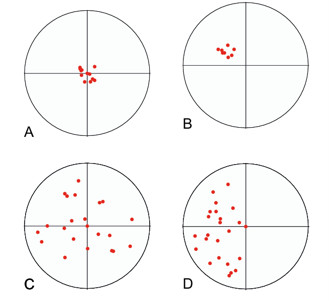
Fig. A: Precise and Accurate
Fig. B: Precise but not Accurate
Fig. C: Accurate (average is centered) but not Precise
Fig. D: Not Accurate (average is not centered) and not Precise
How do I select the right Fast Steering Mirror for my application?
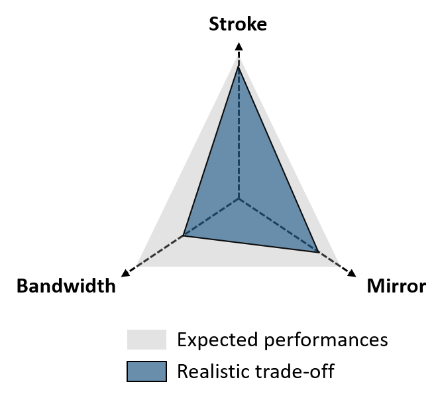
To select the right Fast Steering Mirror, first define the main requirements such as mirror size, stroke, control bandwidth, and resolution, etc.
There is always a trade-off between performances, especially between stroke, bandwidth, and mirror size. Because of that, all parameters cannot be maximized at the same time and must be balanced depending on the application.
Technical Selection
What is the difference between piezoelectric and magnetic fast steering mirrors?
Piezoelectric Fast Steering Mirror: Uses piezoelectric actuators for beam steering mechanism. It can perform up to ~1° mechanical angular stroke (≈20 mrad pk-pk) and high bandwidth (>1 kHz).
Magnetic Fast Steering Mirror: Uses Moving Iron Controllable Actuators (MICA™) and provides a larger angular stroke up to ~5° mechanical angular stroke (>50 mrad pk-pk), with a bandwidth up to ~300 Hz (-3 dB).
What is the difference between Moving Iron Controllable Actuators (MICA™) and Voice-Coil Actuators (VCA)?
Moving Iron Controllable Actuator (MICA™): The MICA™ actuator uses a controlled magnetic field, where a permanent magnet creates a fixed magnetic field and coils actively modify this field to control the force on a moving iron part, enabling bidirectional motion.
Voice-Coil Actuator (VCA): The voice-coil actuator works by passing current through a coil placed in a permanent magnetic field, where the Lorentz force directly moves the coil (or magnet) to produce linear motion.
Compared to voice-coil Actuator, MICA™ technology offers low self-heating, low power consumption, lightweight design, compact size, and additional system advantages.
How can I choose a mirror to integrate into a Fast Steering Mirror?
Cedrat Technologies can integrate custom mirrors using Silicon Carbide (SiC), Silicon Dioxide (SiO₂), Aluminum (Al), or other substrate materials with high-reflectivity optical coatings depending on the application requirements.
These mirrors can be optimized for applications such as high-energy laser (HEL) weapon systems and industrial laser processing, including laser cutting, laser welding, and other high-power laser applications.
For customers who already have a mirror or a preferred supplier, we can also provide the FSM mechanism without the mirror, allowing integration of your custom mirror into the Fast Steering Mirror.
How to choose a compatible control driver (electronics) for a Fast Steering Mirror?
The control electronics depend on the FSM technology (Piezo or magnetic) and whether the system operates in open-loop or closed-loop control.
Controller for the Piezo FSM:
- CCBu20-NS: Compact dual-axis controller board optimized for New Space applications and designed to withstand harsh environments such as radiation and vibrations
- CCBu20 & CCBu40: Compact all-in-one dual-axis controllers with integrated closed-loop control and dedicated PID algorithms. Different power levels are available to match the required FSM performance.
- CAu10: Extra-miniature two-channel amplifier for open-loop control.
- Rack-based Drivers: The rack-based electronics dedicate for laboratory applications and include powered racks (RK42F-3U, RK42F-4U, RK84F-4U), amplifier boards (LA75, SA75, SP75), sensor conditioners (SG75, ECS75), and digital controller boards (UC55).
Controller for the Magnetic FSM:
- The MCLA18 and MCSA480 are compact switching amplifiers designed for efficient control of M-FSM mechanisms.
What sensors are used in closed-loop Fast Steering Mirror?
Sensors are used for fine motion control and are generally required for closed-loop control to improve accuracy, resolution, and beam stabilization.
Two sensor technologies are available:
- Strain Gauges (SG): Contact sensors that measure deformation. They are the standard sensor option for most piezoelectric Fast Steering Mirrors.
- Eddy Current Sensors (ECS): Contactless sensors that measure distance. They are a standard option in some Piezoelectric Fast Steering Mirrors and can also be used with Magnetic Fast Steering Mirrors.
Applications and Solutions
What are the industrial applications of Fast Steering Mirror?
Space & New Space:
CEDRAT Technologies has over 30 years of space heritage. Fast Steering Mirrors are used in Optical Communication Terminals (OCT) for Optical Feeder Links(OFL) and Optical Inter-Satellite Links (OISL), Earth Imaging, supporting beam stabilization, jitter stabilization, and Point Ahead Mechanism (PAM)
Optronics & Defense:
Fast Steering Mirrors are used in electro-optical systems including gimbals, Infrared Search and Track (IRST) systems, and super-resolution IR cameras. They are also used in High-Energy Laser (HEL) systems for beam stabilization, Beam wander cancellation and vibration compensation.
Laser Material Processing:
Fast Steering Mirrors are used in laser machining systems for wobble technology to improve performance in laser cutting, laser welding, laser drilling, laser marking, surface structuring, and additive manufacturing(AM).
Environment Conditions & Space Qualification
Can Fast Steering Mirror operate in space, vacuum, or harsh environments?
CEDRAT Technologies has over 30 years of space heritage. CTEC Fast Steering Mirrors are space-qualified and designed to operate in vacuum, wide temperature ranges, radiation environments, and other harsh environmental conditions.
We can also supply & qualify FSM solutions for different environmental requirements depending on the customer application and qualification level needed.
About our company
General information
Who is Cedrat Technologies?
Cedrat Technologies (CTEC) is a French high-tech company specializing in advanced mechatronic technologies. CTEC develops smart actuators, mechanisms, sensors, driving electronics and complete mechatronic systems for demanding industrial, scientific, aerospace and optoelectronic applications.
What does Cedrat Technologies do?
Cedrat Technologies (CTEC) designs, develops, manufactures and industrializes advanced mechatronic products and systems. CTEC’s expertise covers mechanisms, piezoelectric and magnetic actuators, sensors, electronics and control systems. CTEC can support projects from feasibility studies and conceptual design through prototyping, testing, qualification and industrialization.
Where is Cedrat Technologies based?
Cedrat Technologies (CTEC) is headquartered in Meylan, near Grenoble, France, within one of Europe’s major technology and innovation hubs. CTEC also operates internationally through subsidiaries, including Cedrat Technologies India and Cedrat Technologies Shanghai in China.
How long has Cedrat Technologies been developing advanced mechatronic technologies?
Cedrat Technologies (CTEC) has several decades of experience in advanced mechatronics and more than 30 years of experience in space applications. CTEC’s space activities began with CNES in the 1990s and contributed to the development of technologies such as the patented APA® Amplified Piezoelectric Actuator.
Industries and Solutions
What industries does Cedrat Technologies serve?
Cedrat Technologies (CTEC) serves a wide range of demanding industries and applications, including Space and New Space, Optronics, Scientific Instrumentation, Aircraft, Production Machinery and Medical Technologies. CTEC’s technologies are used when applications require precise motion, high positioning accuracy, fast response, vibration control or compact mechatronic solutions
Does Cedrat Technologies develop custom mechatronic systems?
Yes. Cedrat Technologies (CTEC) develops customized mechatronic systems when standard products do not fully meet an application’s requirements. CTEC’s custom developments can combine mechanisms, actuators, sensors, dedicated electronics and control systems, with each element adapted to the customer’s technical specifications and operating environment.
Does Cedrat Technologies offer both standard products and custom solutions?
Yes. Cedrat Technologies (CTEC) offers a portfolio of standard mechatronic products that can be used as building blocks, as well as fully customized solutions developed for specific applications. CTEC’s standard products can help accelerate development, while CTEC’s custom engineering allows the mechanism, actuation, sensing, electronics and control system to be adapted to specific performance and integration requirements.
Can Cedrat Technologies develop a complete mechatronic system?
Yes. Cedrat Technologies (CTEC) can develop complete mechatronic systems by combining several disciplines within a single project. Depending on the application, a system can integrate a mechanism, piezoelectric or magnetic actuation, sensors, dedicated driving electronics and control software. CTEC’s multidisciplinary engineering teams work together throughout the development process to ensure system-level performance and integration.
Engineering and Product Development
What services does Cedrat Technologies provide during a product development project?
Cedrat Technologies (CTEC) can support customers throughout the product development lifecycle. Services may include feasibility studies, pre-design, detailed design, prototyping, manufacturing, assembly, integration and testing (MAIT), qualification and industrialization. CTEC can adapt the development process to the project’s technical requirements, production objectives and target market.
Can Cedrat Technologies support a project from concept to industrial production?
Yes. Cedrat Technologies (CTEC) can support projects from the early stages of feasibility and concept definition through design, prototyping, testing, qualification and industrialization. By combining engineering and manufacturing expertise, CTEC can address technical performance, manufacturability, quality, cost, supply chain and production requirements throughout the development process.