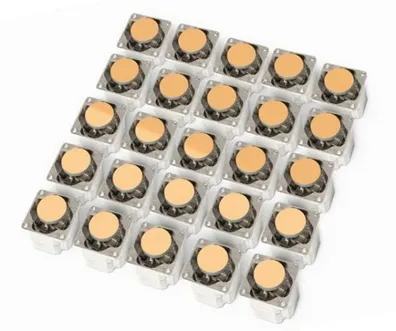

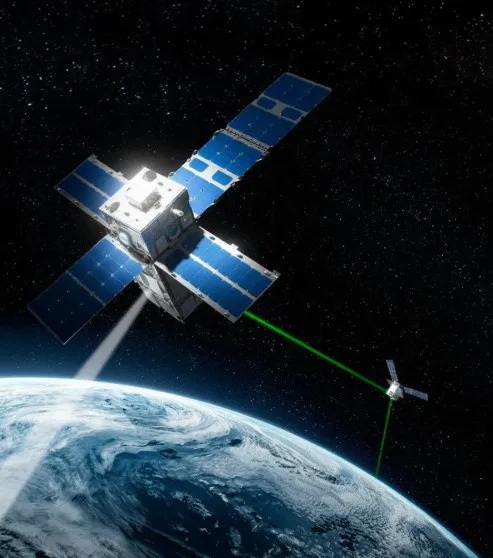
Free-Space Optical Communication (FSO) is rapidly expanding with the deployment of large satellite constellations and the development of Optical Inter-Satellite Links (OISL) operating between LEO, MEO, and GEO orbits. These architectures rely on Optical Communication Terminals (OCTs) embedding Fine/Fast Steering Mirrors (FSM) to compensate for platform jitter, pointing errors, and micro-vibrations while maintaining high optical link stability. The emerging New Space market introduces stringent constraints in terms of size, weight, power consumption (SWaP), cost, manufacturability, and scalability, with constellation programs requiring tens of thousands of FSM units.
CEDRAT TECHNOLOGIES has addressed these challenges through the CONECS project, focusing on the development of space-qualified piezoelectric FSM and associated drive electronics optimized for LEO constellation environments. Leveraging extensive flight heritage, the project has delivered a new generation of FSM combining high pointing performance, robustness to launch and in-orbit conditions, and cost efficiency suitable for large-series production.
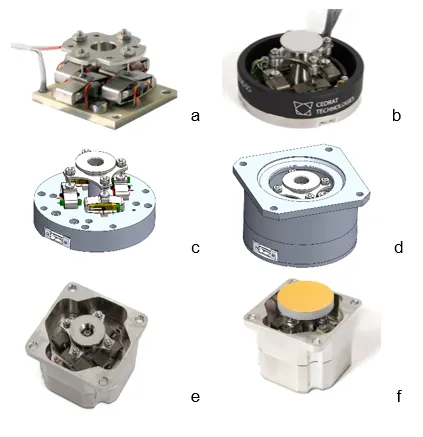
The P-FSM35XS, derived from the DTT35XS mechanism with proven performance on missions such as PHARAO and PAM30, has been optimized for New Space applications. The updated design achieves a 27% increase in angular stroke, reaching up to 6.1 mrad, while maintaining bandwidths compatible with FSO stabilization requirements. Design improvements include simplified half-bridge strain-gauge sensing, integrated offset compensation at the mechanism level, reduced wiring complexity, and improved manufacturability, resulting in enhanced reliability and system-level interchangeability.
For larger pointing amplitudes, the P-FSM150S provides up to 18 mrad mechanical stroke using newly developed amplified piezoelectric actuators (APA150S). Its innovative flexible mirror support accommodates both screw-mounted silicon carbide (SiC) mirrors for high-reliability missions and cost-optimized fused silica (SiO₂) mirrors for New Space COTS variants. Qualification and life tests demonstrate sub-20 µrad resolution, resonance frequencies above 700 Hz, launch-load tolerance, and lifetimes exceeding 10⁹ actuation cycles. Optical bench tests confirm significant improvements in beam stabilization and pointing accuracy.
These FSM systems are controlled by the CCBu20-NS dual-channel piezo controller, providing push-pull actuation, strain-gauge conditioning, digital closed-loop PID control with tunable notch filters, and embedded telemetry and telecommand interfaces. The controller supports closed-loop bandwidths above 250 Hz and radiation tolerance up to 30 krad, enabling reliable operation in New Space LEO missions.
Together, these developments constitute a coherent, scalable, and cost-effective FSM portfolio from CEDRAT TECHNOLOGIES, specifically addressing the pointing and stabilization needs of SmallSat optical communication constellations.